 Spanish
 English
 Italian
 Portuguese
 French
Welcome to Our Blog - Nextech 2026: Discovering Where the Textile Industry Is Headed
Nextech 2026: Discovering Where the Textile Industry Is Headed

- Textile industry
- Oct 14, 2026
Nextech 2026: Discovering Where the Textile Industry Is Headed
From September 22 to 24, we attended the first edition of Nextech by Colombiatex at Plaza Mayor in Medellín. It is Latin America’s first trade show specializing in machinery and technology for the textile and apparel supply chain. According to Inexmoda, Colombia accounted for 6.8% of the Latin American fashion market in 2025—approximately USD 8,494 million—and the industry is asking itself how to produce better, not just more.
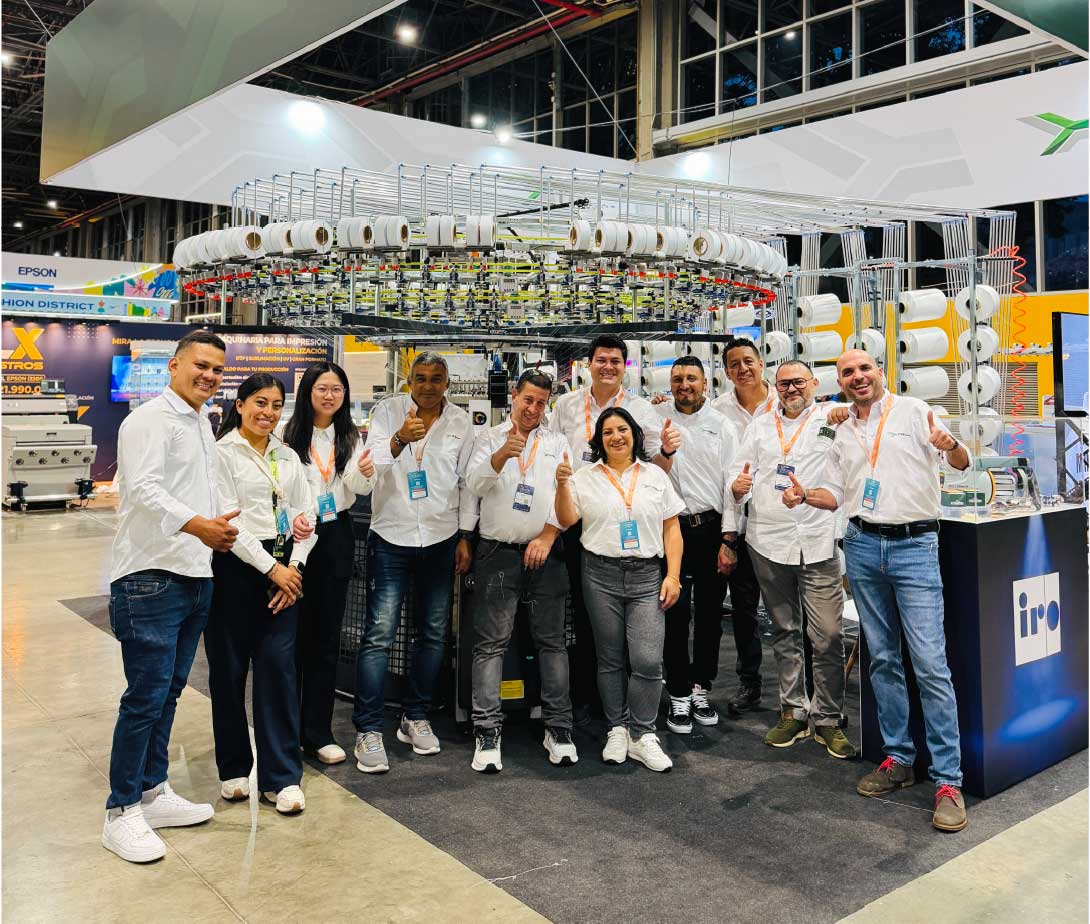
At our booth, we had knitting looms, braiding machines and SINOTEX flat knitting looms in operation. We had visitors from different cities in Colombia, as well as from Ecuador, Peru, Argentina, and Europe, and a good portion of them were companies we hadn’t worked with yet. Almost all conversations revolved around four topics.
Topic 1: Knitting remains the foundation, but growth doesn’t always mean buying another machine
This was the most frequently asked question. Before adding a machine, check if you can diversify with the one you already have:
Change parts, not the machine. On single-knit knitting machines, by changing the core components, the same machine can be converted to knit terry or polo fabric.
Change the gauge with a new cylinder. You can produce a different type of fabric with the same equipment and a much smaller investment than that of a complete machine.
Choose wisely between tubular and open-width knitting. If you work with fabrics containing Lycra or light colors and the fold of the tube leaves marks, the open-width method rolls up the spread-out fabric, preventing those wrinkles and maintaining a uniform stitch density. If you produce garments without side seams, the tubular method remains the most efficient option.
Topic 2: For collars and cuffs, the difference lies in the design
Every technique you master is one more product you can offer: mini jacquard, embossed pleats, intarsia, transfers, or shaped collars. If you’re evaluating a flat knitting machine, keep this in mind:
Rising and lowering rollers: the fabric comes out straight without needing to be hung by hand.
High-heel needles: the cams wear less.
Servo-controlled motor: according to the manufacturer, it increases production by 15%.
Four lancing bars and eight feeders: more colors in a single design.
Topic 3: In braiding, continuity comes down to the details
Braiding is used in shoelaces, sports and safety ropes, fishing line, headphone cables, and jacquard cords, made of polyester, nylon, PP, or Dyneema. If you’re considering a braiding machine:
It’s part of the final product. The number of spindles and heads determines what you can produce and at what rate.
Look for an automatic shut-off in case of thread breakage to avoid accumulating defective lengths. According to the manufacturer, some rope-making models produce 4 to 5 times more than a traditional braiding machine.
Keep consumables close at hand. With spools, carriers, springs, and brake pins readily available, a stoppage lasts hours rather than weeks.
Think about the finishing. If you produce cords, an automatic stitching machine capable of 4,000 to 6,000 stitches per hour completes the process without relying on manual labor.
Topic 4: The cutting room has become a major topic of conversation
Automatic fabric spreading and cutting machines—a line we recently introduced with YINENG TECH—were among the most frequently inquired about. Fabric typically accounts for 60% to 70% of a garment’s cost, and Lectra estimates that waste in cutting rooms ranges from 10% to 20%. It is one of the largest cost centers in a garment manufacturing operation and almost always the least measured.
Before looking at any technical specifications, measure these four things over the course of a typical month: your marking efficiency by garment type, your scraps and rework by cause, the actual hours your cutting table is in use, and your true bottleneck (consistency, setup time, or volume). Also, evaluate spreading and cutting together. An automatic cutting machine only cuts the fabric layout it is fed. If the fabric is still laid out by hand, you’ve automated the precise step and left the imprecise one as it was.
Before Making a Decision
Anyone returning from a trade show comes back with options on the table. These four questions help you sort through them:
What are you going to produce, and for which market?
What is the actual productivity with your yarn and your shifts?
Are replacement parts available nearby?
What does the support for installation, commissioning, and training include?
Most decisions to invest in machinery are made months after a trade show, when there’s time to compare options calmly. We’ve seen this happen in other divisions of the group, which is why we never consider any conversation closed. If you submitted a request, our sales team will reach out to you to help bring it to life. And if you didn’t get a chance to visit us or want to discuss any of these topics for your plant, please write to us.
Thank you to everyone who stopped by to visit us during Nextech.